

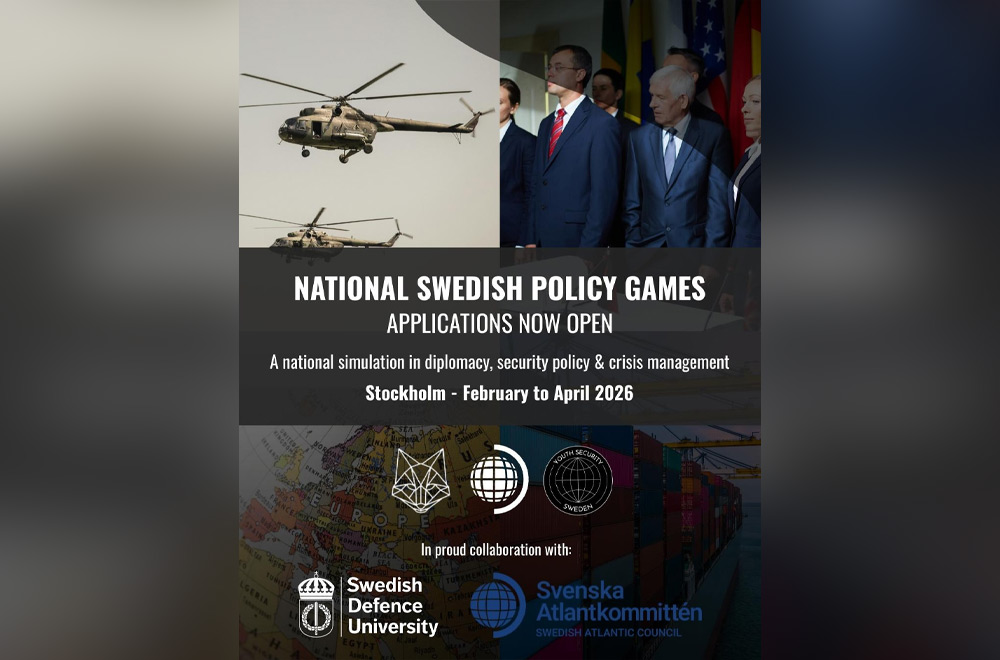
National Swedish Policygames 2026
Introduction
Welcome to the guide for the first-ever edition of the National Swedish Policygames, organized by YATA Sweden, Utrikespolitisk Afton and Youth Security Sweden in proud cooperation with the Swedish Atlantic Council and the Swedish Defence University. This information package is intended to give you as a participant the best possible foundation to make the most of this event and to ensure a smooth flow and productive discussions throughout the competition. Below you will also find information and support for the preparations you will need to make before the competition begins on the 2nd of February:
- To read and understand all the rules and procedures to ensure a smooth flow during the competition.
- To follow current geopolitical trends in order to understand the coming scenario, who’s implications will shape your Policy Recommendations and subsequent Decision Documents.
- To read and understand all benefits and obligations as an admitted participant of this
The goal of the National Swedish Policygames competition is not only to crown a winning team, but also to facilitate learning and understanding for a cohort of students across all academic disciplines. Through the practical employment of writing- and presentational skills, backed by research and previous academic knowledge, the competition aims to create a unique learning experience for all that share a common interest in diplomacy, security policy and geopolitics. By competing in teams, as well as meeting other teams from other institutions of higher education around Sweden, the competition has the additional benefit of bringing these like-minded students together, facilitating lasting connections and peer-to-peer learning that will benefit all participating parties moving forward.
Link to application: https://forms.gle/EDK48dWJDXV48R8EA
Procedures and Rules
Teams
- Each team consists of four students currently enrolled at a Swedish college or university during the duration of the competition. There is no specific subject or course needed to participate, although a background or interest in diplomacy, security and defence will prove useful.
- Teams consisting of fewer than four students may still be considered for admittance at the discretion of the organizers.
- Applying and participating teams are advised to seek a coach among the faculty staff at their respective university in order to help craft their Policy Recommendations. While their participation in Stockholm will not be sponsored, their presence at the SEDU would be However, there they will only be able to support their team in-between rounds of policy presentations, and not during the presentation itself. They may also participate online through the facilitation of their respective team.
- All teams are also encouraged to seek funding from their respective institutions should the reimbursements provided by the organizers of the NSP 26 not suffice in order to facilitate the team’s participation.
Procedure
- Firstly, when the application period ends on the 2nd of February, all admitted teams will be notified of their success and receive the scenario for the competition. All admitted teams will then produce a policy brief and a decision document according to the instructions found in this These documents will then be handed in by a single member of the group before the 27th of February.
- Secondly, all progressing teams will be notified by the 13th of March and given a month to make their arrangements in order to be present for the competition taking place at the Swedish Defence University in Stockholm. Partial reimbursements for costs associated with travel and accommodation will be paid out after the competition has ended. During this time all progressing teams are also expected to produce a second policy recommendation to present during the quarter final on the 17th of Details of which may be found further down in this document.
- Thirdly, after the first round of policy presentations at the SEDU, the judges select the proceeding These will then be given a limited amount of time to prepare a third round of policy recommendations, while the eliminated teams will be free to spectate or discover the city of Stockholm.
- Fourthly, all proceeding teams will present their third round of policy recommendations, after which, the judges will announce the teams selected for the final round.
- Lastly, after the finalists have presented their policy recommendations, a winning team will be chosen, after which the competition will conclude.
Preparations
- The Policy Recommendation is limited to 500 words during all rounds of the competition. This document should summarize the context which has prompted the recommendation, identified the relevant stakeholders and outline the implications of the scenario.
- The Decision Document is limited to one page in length during all rounds of the competition. This document will serve as the only presentational aid given to the judges during the Policy Presentation, and will be distributed to the panel of judges before and accompany the respective Policy While there is no limitation to using graphs, statistics, font or size, it should be as concise as possible as the panel of judges will only have 2 minutes to read it before the Policy Presentation begins.
- The Policy Presentation is limited to 10 minutes during all rounds of the competition, after which 10 minutes of questioning by the jury will follow. This presentation should briefly summarize the scenario, its implications and stakeholders, and devote the greatest amount of time to the Policy Recommendations No presentational aid is allowed (such as PowerPoints or posters) and supportive notes may only be brought in the form of paper.
- While use of electronic devices is allowed during the time allocated for the authoring of the Policy Recommendations, it will be strictly prohibited during the succeeding rounds of Policy Presentations. This in order to minimize the potential of cheating or other forms of rule-breaking. Therefore, bringing paper and pen is highly recommended to facilitate peer-to-peer learning during the presentations.
During the Competition
- All organizing parties reserves the right to take photos and videos for their respective media use, as well as partner with third parties to provide coverage of the Additionally, members of the media may be invited to observe and report on the competition as it unfolds. All due respect will be shown to participants that put forward their objection to being depicted in said media coverages.
Procedure of the Policy Presentations
- The series of presentations will begin at the time set in the schedule at the bottom of this document. The organizers will not wait for all participants to be present before commencing. If a Policy Recommendation or Decision Document is not handed in in due time, it will not be graded and therefore cause the team to lose out on This may be done electronically if access to printers prove limited during the competition.
- The series of presentations will commence with announcing the order in which the teams will This will be unknown to the teams beforehand. Then each team will be called forth to present their Policy Presentation.
- The panel of judges will then read through the presenting team’s Decision Document for two minutes before giving the floor to the presenting team. The team will then have a maximum of 10 minutes to present, followed by 10 minutes of direct questioning by the panel of judges.
- The subsequent team will then repeat the process until all teams have presented their Policy Presentations. The panel of judges will then convene for their internal deliberations and grading while the participating teams will have lunch and network with the other participants, after which the judges will announce the results of the current round.
Rules of the Policy Presentations
- The Policy Presentation may not exceed 10 minutes in length. The presenting team will be shown cards as to inform them of the remaining time, with green meaning five minutes left, yellow meaning three minutes and red meaning one minute. A penalty will be given to teams that exceed the time limit.
- All outside assistance and use of electronic devices is strictly prohibited during the series of Policy Presentations. For clarification: this encompasses the time of the gathering of all teams before the first presentation until the last team have presented, after which time will be given to author a new policy Recommendation where the use of electronics is allowed. Any suspicion of cheating may result in immediate disqualification.
Criteria and Grading Aspects
- The submitted Policy Recommendation (1), Decision Document (2) and Presentation (3) will be graded by an expert panel consisting of subject experts and professionals in the themes relevant to the scenario. These will grade the three components of a team’s performance based on the following five criteria.
- Understanding of foreign- and security policy.
[4 points] The team demonstrated a comprehensive knowledge of foreign- and security policy issues, accurately identified key stakeholders and applicable instruments/levers
[3 points] The team demonstrated a good knowledge of foreign- and security policy issues, identified appropriate stakeholders and instruments/levers
[2 points] The team demonstrated a general understanding of foreign- and security policy but mis-identified some appropriate stakeholders and instruments/levers
[1 point] The team demonstrated a limited knowledge of foreign- and security policy, stakeholders and instruments/levers
- Identification of key issues.
[4 points] The team successfully identified and fully responded to all the issues posed by the scenario
[3 points] The team identified and responded to the main issues posed by the scenario
[2 points] The team identified some relevant issues posed by the scenario or partially responded to the main issues identified
[1 point] The team referenced general international issues not relevant to the scenario or overly focused on a single issue
- Structure and communication.
[4 points] The team presented with a very clear, logical structure to their analysis and options, clearly communicated with the audience and were exemplary (brevity & accuracy) in their responses to questions
[3 points] The team presented with a logical structure to their analysis and options, communicated relatively well with the audience and gave good answers in response to questions
[2 points] The team presented with an occasionally unclear structure to their analysis and options, occasionally struggled to clearly communicate with the audience and / or occasionally gave unclear answers in response to questions
[1 point] The team’s presentation of analysis and options lacked structure, hindering effective communication with the audience and gave unclear answers in response to questions
- Originality and creativity.
[4 points] The team offered highly effective and innovative solutions to the scenario that go beyond existing canonical literature or best practices
[3 points] The team offered effective, creative solutions to the scenario, grounded in current best-practices and literature
[2 points] The team offered partially effective solutions to the scenario with a degree of creativity, drawing upon some superseded best practice
[1 point] The team offered potentially ineffective solutions to the scenario, without creativity or drawing upon superseded best practice
- Quality and nuance of proposed policies.
[4 points] The team’s policy response options fully addressed the scenario and clearly articulated trade-offs. The optimal solution was proposed
[3 points] The team’s policy response options addressed the main elements of the scenario and articulated some trade-offs. A good solution was proposed
[2 point] The team’s policy response options addressed some elements of the scenario and / or there was limited articulation of trade-offs. A solution that had some value was proposed
[1 point] The team’s suggested responses were overly narrow or only focused on one element of the scenario. The proposed solution was unlikely to be successful
- Scoring and feedback will be given to each presenting team after the judge’s deliberations and announcement of proceeding teams.
- If a team is eliminated and not selected to proceed in the competition, they are most welcome to stay and take part in the following rounds of presentations and after-party at the SEDU Mess. Please note that eliminated teams are still eligible for some of the prizes that are handed out during the concluding ceremony on the 17th of April.
- Besides the main prize awarded to the winning team, additional recognition will be given to teams and participants in order to award outstanding This in the form of separate awards for Best Policy Presentation and Best Policy Proposal.
Assistance and Cheating
- Before the competition, all teams are encouraged to seek expert assistance in the process of creating their Policy Recommendations in order to foster learning and networking between subject experts and students. This includes the draft of the second round of Policy Recommendations.
- During the last two rounds of the competition, taking place at the Swedish Defence University, all outside assistance and mentoring is strictly prohibited. Teams may only discuss the drafting of the third and fourth round of Policy Recommendations among themselves. The use of electronic devices is only allowed between the series of Presentations.
- All Policy Recommendations and Decision Documents will be tested for the influence of AI before becoming eligible for grading, and subsequently point-giving, during the entire duration of the competition.
- All participating teams are expected to uphold the highest standard of academic integrity during the duration of the Any suspicion or instance of cheating will result in immediate disqualification and retraction of granted reimbursements. If a team is found cheating, their institution will be informed of the disqualification.
Schedule for the Swedish National Policygames 2026
17th of April 2026
09:00 – 09:30 | Welcome ceremony
- Address by the organizers
- Welcoming words by the SEDU Principal Robert Egnell
09:30 – 11:30 | First round of policy presentations
- Non-presenting teams attend the presentations as audience.
- Ten minutes are allocated for each team to present their policy recommendations, followed by ten minutes of questioning by the jury.
- A 30min break is allocated for the jury during this time (after 5 policy presentations), during which fika will be served.
11:30 – 12:30 | Lunch
- The jury deliberates on their selection of the proceeding teams.
- The teams eat lunch, discuss feedback and network .
12:30 – 13:30 | Announcement and preparations for the second round of policy presentations
- The results from the first round is announced.
- The next evolvement is announced by the author of the scenario: Karl Agell, Vice Chair of Utrikespolitisk Afton and Analyst at Frivärld.
- The proceeding teams have until 13:30 to research, author and hand in their Decision Document.
13:30 – 15:00 | Second round of policy presentations
- Non-presenting teams attend the presentations as audience.
- Ten minutes are allocated for each team to present their policy recommendations, followed by ten minutes of questioning by the jury.
- A 20min break is allocated for the jury during this time (after 5 policy presentations), during which fika will be served.
15:00 – 15:30 | Jury scoring and deliberation
15:30 – 16:00 | Announcement and preparations for the final round of policy presentations
- The results from the first round and the next evolvement is announced by the author of the scenario: Karl Agell, Vice Chair of Utrikespolitisk Afton and Analyst at Frivärld.
- The proceeding teams have until 16:00 to research, author and hand in their Decision Document.
16:00 – 16:30 | Final round of policy presentations
- Non-presenting teams attend the presentations as audience.
- Ten minutes are allocated for each team to present their policy recommendations, followed by twenty minutes of questioning by the jury.
16:30 – 17:00 | Final jury scoring and deliberation
17:00 – 17:30 | Winner announcement
- The winning team is declared and the prizes are awarded.
- Final words by the organizers.
17:30 – late | Optional after-party in the SEDU Mess
Disclaimer: Schedule is subject to change.